

.png)
Using RuleWatcher to Analyze One Health Policies Addressing Global Biodiversity Loss and Zoonotic Disease Risk
- Publishing Team

- Jun 11
- 8 min read
Updated: Aug 6
Author

Originally from the Republic of Guinea, I am a Public Health and Nutrition Specialist with expertise in both program management and teaching. In 2023, I was awarded the Japan International Cooperation Agency Scholarship under the African Business Education (ABE) Initiative program, which allowed me to pursue my MPH studies at St. Luke’s International University and broaden my global perspective on health, business development, and international cooperation.
My academic journey has been complemented by diverse international experiences, including internships with Sora Technology, Policy Garage, and the International Support and Partnership for Health, all of which have significantly contributed to both my personal and professional growth.
I am passionate about leveraging my expertise to improve health outcomes globally
1-Key finding
This use case looked at how global policies between 2020 and 2026 connect biodiversity protection with the prevention of diseases that spread from animals to humans. Using the RuleWatcher platform, we reviewed policy documents, reports, and discussions related to biodiversity and One Health governance.
The results showed growing global awareness that human, animal, and environmental health are closely linked. Important initiatives included the WHO Pandemic Agreement, the Belém Health Action Plan, biodiversity and pandemic risk frameworks, wildlife trade regulations, and disease surveillance programs led by international organizations.
2-Overview
The World Health Organization describes One Health as a Holistic approach that brings together human, animal, and environmental health to achieve sustainable and optimal well-being [1]. Whereas, Biodiversity refers to the variety of all living things on Earth, encompassing plants, animals, microorganisms, and the ecosystems they form. It is essential for human life, as it provides food, clean water, and energy, and helps control diseases and maintain a healthy environment[2].
Biodiversity loss is not only an environmental crisis, but also a public health warning. As ecosystems are degraded and human-animal interactions intensify, the risk of zoonotic disease spillover rises [2], making One Health policy coordination more urgent than ever.
This use case aims to identify recent One Health policy actions that connect biodiversity protection with zoonotic disease prevention, and to understand how governments and international institutions are translating the One Health approach into practical decisions.
3-Research Description
It is estimated that more than 75% of emerging infectious diseases, such as Ebola or the Nipah virus, are zoonotic, and most of them originate from animals [2]. These infectious diseases often arise in areas where ecosystems and habitats have been disrupted by deforestation or land-use change [2].
The issue of zoonotic diseases is global. In Latin America, the rising wildlife trade threatens ecosystems and increases disease transmission risks [3, 4]. In Southeast Asia, close human–wildlife interactions continue to create conditions for zoonotic spillover [5, 6]. Meanwhile, in island nations and developing regions, governments are strengthening biosecurity infrastructure to prevent zoonotic disease outbreaks before they occur [7, 8, 9].
The purpose of this research was to identify and analyze recent policies and regulatory actions linked to biodiversity conservation and zoonotic disease prevention under the One Health framework. To achieve this, RuleWatcher was used to track and extract relevant articles that were used in this analysis. In addition, ChatGPT was used to draft the content of this article.
The research was conducted over a period of approximately 3 weeks, focusing not only on learning how to efficiently use RuleWatcher for research but also on extracting and analyzing primary policy data and official reports. This approach was useful for developing a more accurate understanding of how One Health policies are being implemented globally.
4-RuleWatcher Data Extraction
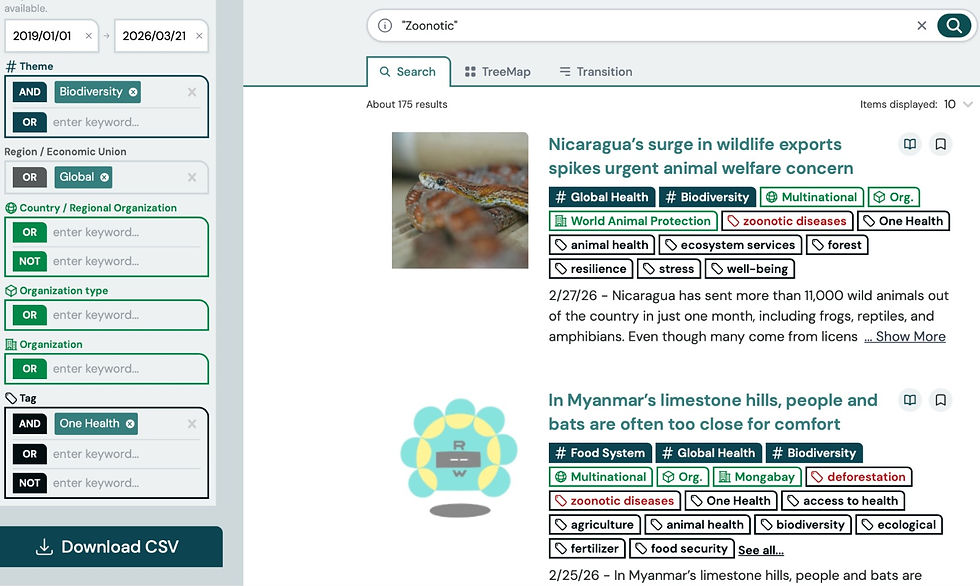
The search began by logging into the RuleWatcher platform and locating the “Global Environment” theme. Under this theme, “biodiversity” was selected, as it was one of the key terms for this research.

Then, the term “zoonotic” was entered into the search bar, yielding a total of 889 results.

However, these results reflected a broad scope. To better align with the research title and focus, filters were applied based on date, region (global), and the “One Health” tag. This refinement reduced the results to 175 articles.
Using the Transition “heatmap” (see the figure below), we could observe trends in One Health policies related to zoonoses between 2019 and 2026. A significant surge in policy development occurred during 2020 and 2021, likely driven by the COVID-19 pandemic and the resulting strict public health measures.
After this surge, the trend appears to stabilize from 2022 onward, with sustained but comparatively moderate levels of policy attention. This pattern suggests a shift from reactive, crisis-driven policymaking toward more structured and institutionalized approaches to zoonoses within the One Health framework.

Additionally, using the TreeMap function, it was observed that the articles included in this analysis originated from a wide range of sources. This highlights both the complexity of biodiversity and One Health concepts and the diversity of factors contributing to the occurrence of zoonotic diseases.

All the displayed topics on the TreeMap are relevant to this analysis. For example, by selecting the “G20” topic, it was possible to access statements such as: “The One Health approach is beneficial for people, animals, and the planet.” In addition, the G20 action plan addressing zoonotic threats was also visible, as shown below.

5- Data analysis
The analysis involved uploading the downloaded RuleWatcher data into ChatGPT and applying the following detailed prompt to generate the desired outputs.
Prompt: You are a senior global health policy researcher and One Health specialist with expertise in biodiversity governance, zoonotic disease prevention, and pandemic preparedness.
Analyze the uploaded RuleWatcher dataset and identify all policies, rules, and regulations related to One Health, biodiversity conservation, wildlife protection and trade, animal health surveillance, pandemic preparedness, and zoonotic disease prevention
Tasks:
1- Identify and extract all relevant One Health policies addressing biodiversity loss and zoonotic disease risk from the dataset.
2- For each relevant policy, extract policy title, country/region, year, responsible institution, policy objectives, target sectors, mentioned zoonotic risks, biodiversity-related concerns, and One Health component(s). Briefly summarize this section in plain language.
3- Verbally analyze One Health policies addressing biodiversity loss, wildlife exploitation, and zoonotic disease risks
4- Identify best practices, policy gaps, weak implementation areas, underrepresented regions, and implementation challenges
5- Produce a conclusion on key findings and the recommendations for strengthening One Health governance globally
The final output should be written in an organized and policy-analysis style suitable for institutional reporting.
6- Finding and usefulness
The analysis showed that more countries and international organizations now recognize that human, animal, and environmental health are highly connected [8]. Many of the policies and initiatives support the One Health approach, which encourages governments, conservation groups, veterinary services, and public health organizations to work together to prevent future pandemics and reduce environmental risks [10, 8].
Most policies highlighted that biodiversity loss, deforestation, wildlife trade, climate change, and ecosystem damage increase the risk of diseases spreading from animals to humans [4, 5, 11, 12]. Several initiatives, such as the Pandemic Treaty discussions, wildlife disease monitoring guidelines, and biodiversity governance frameworks, call for stronger cooperation between sectors, better disease surveillance systems, sustainable land use, and improved control of wildlife exploitation [11, 10, 13].
There was also a growing effort to include environmental governance in public health planning [8, 12, 14, 16]. Organizations such as WHO, FAO, UNEP, IUCN, WOAH, and regional partners are promoting integrated surveillance systems, ecosystem-based prevention methods, and community-focused approaches [8, 10]. However, challenges in implementation still exist in many regions, especially in low-resource areas [7, 15], although this might also be due to data availability on RuleWatcher.
7- What Worked Well in Combination with Other Tools
RuleWatcher was very useful because official policy documents, institutional updates, and expert comments were accessible in one place. Without it, finding this information would have been difficult and very time-consuming. This was especially important for a broad topic like One Health, where information is spread across environmental, agricultural, health, land use, and biodiversity-related organizations.
Using RuleWatcher together with ChatGPT reduced the research time and made it easier to identify policies, analyze information, and write the article. In addition, checking each point against the original RuleWatcher records helped ensure the article was accurate and relevant.
8- Comparison of RuleWatcher With Other Tools
Although other search engines and academic databases provide good access to information, they do not offer the same real-time data collection, multilingual translation features, and policy-focused content as RuleWatcher. RuleWatcher allows users to quickly download multiple articles at the same time and provides useful summaries and additional information, making it especially valuable for policy research. So, to the best of my knowledge, no single tool currently offers the same combination of features provided by RuleWatcher.
9- Conclusion
This use case shows that the One Health approach is becoming increasingly important in connecting public health, biodiversity protection, climate resilience, wildlife conservation, and pandemic preparedness. Many international organizations now recognize that biodiversity loss, environmental damage, and wildlife exploitation increase the risk of diseases spreading from animals to humans.
The analysis also shows growing efforts to improve disease surveillance, protect ecosystems, and strengthen cooperation between sectors. However, many countries still face financial, institutional, and operational challenges in implementing these policies.
To strengthen global One Health governance, more investment, better wildlife trade regulation, stronger cooperation between institutions, and greater support for low-resource countries are needed. Future efforts should focus on prevention, environmental protection, community participation, and better data sharing to improve global health security.
10-Use of RuleWatcher: Advantages and Recommendations
RuleWatcher was highly useful for this analysis. Without it, the time required to complete this use case would have been much longer, and gathering the information contained in this document within such a short period using different search engines would have been extremely challenging. The RuleWatcher platform is user-friendly and significantly reduces data collection time.
Having the downloaded dataset available in CSV format further facilitated the analysis process, as the dataset was already well-organized with a summary and detailed information on all articles and their sources. Another important advantage was the availability of both English and Japanese download options. I was able to easily download the dataset in English and proceed directly with the analysis without facing translation challenges.
I strongly recommend RuleWatcher to knowledge seekers, researchers, and policy-makers for use in their various projects. I also recommend that OSINTech make the data available for all countries, especially low-income countries. Additionally, OSINTech should expand the dataset download options to include other major languages such as French, Chinese, Spanish, Portuguese, and Arabic.
11-References
World Health Organization. (2022, May 8). One health. https://www.who.int/health-topics/one-health
World Health Organization. (2025, February 18). Biodiversity. https://www.who.int/news-room/fact-sheets/detail/biodiversity
Pan American Health Organization. (2025, June 30). Yellow fever: How three monkey deaths sparked a critical health alert in Colombia. https://www.paho.org/en/stories/yellow-fever-how-three-monkey-deaths-sparked-critical-health-alert-colombia
International Food Policy Research Institute. (2020). Policy seminar: COVID-19, food systems, ecosystems, and the risk of zoonotic diseases. https://www.ifpri.org/blog/policy-seminar-covid-19-food-systems-ecosystems-and-risk-zoonotic-diseases/
Observer Research Foundation. (2024). Prevent zoonoses: Now or never. https://www.orfonline.org/expert-speak/prevent-zoonoses-now-or-never/
Food and Agriculture Organization of the United Nations. (2020). World Environment Day 2020: Healthy ecosystems are fundamental for preventing global diseases and ensuring food security. https://www.fao.org/newsroom/detail/World-Environment-Day-2020-Healthy-ecosystems-are-fundamental-for-preventing-global-diseases-and-ensuring-food-security/en
Inter-Press Service International Association. (2025, October 28). Tanzania’s Pandemic Fund ushers in a new era of health preparedness. https://www.ipsnews.net/2025/10/tanzanias-pandemic-fund-ushers-in-a-new-era-of-health-preparedness/
Food and Agriculture Organization of the United Nations, United Nations Environment Programme, World Health Organization, & World Organisation for Animal Health. (2022, October 17). One Health joint plan of action to address health threats to humans, animals, plants, and the environment. https://www.unep.org/news-and-stories/press-release/one-health-joint-plan-action-address-health-threats-humans-animals
Food and Agriculture Organization of the United Nations. (2022). One Health approach and intensified collaboration needed to prevent and respond to pandemics. https://www.fao.org/newsroom/detail/one-health-approach-to-prevent-and-respond-to-pandemics/en
International Union for Conservation of Nature. (2024). IUCN and WOAH publish new guidelines for disease surveillance to better protect wildlife. https://iucn.org/story/202410/iucn-and-woah-publish-new-guidelines-disease-surveillance-better-protect-wildlife
Convention on International Trade in Endangered Species of Wild Fauna and Flora. (2024, March 7). Reducing the risk of zoonotic disease emergence associated with international wildlife trade: CITES and WOAH enter new agreement. https://cites.org/eng/news/cites-woah-memorandum-of-understanding-2024-zoonotic-disease-emergence
United Nations Environment Programme. (2022, October 17). One Health for one planet. https://www.fao.org/newsroom/story/one-planet-one-health/en
Think Global Health. (2025, January 21). Prioritizing prevention in the pandemic treaty. https://www.thinkglobalhealth.org/article/prioritizing-prevention-pandemic-treaty
United Nations Environment Programme. (2020, November 12). UNEP joins three international organizations in expert panel to improve One Health. https://www.unep.org/news-and-stories/story/unep-joins-three-international-organizations-expert-panel-improve-one-health
Observer Research Foundation. (2022). Monkeypox epidemic: Ignoring Africa comes at a price. https://www.orfonline.org/expert-speak/monkeypox-epidemic/
World Health Organization. (2022, November 3). Highlights of some key health events at COP27. https://www.who.int/news/item/03-11-2022-highlights-of-some-health-key-health-events-at-cop27


Comments