

.png)
A Grassland to Battleground: How RuleWatcher Assists the Government's regulation to identify Climate Change and Mitigate Herders-Farmers Conflicts
- Publishing Team

- Jan 28
- 6 min read
Updated: Jan 29
Author

Peter Modi Emmanuel Gubang
A South Sudanese national, Local Government Officer (South Sudan)
First-year Master's Student in International Business Law at the Graduate School of International Social Sciences, Yokohama National University (Japan)
Introduction
As a Local Government officer in South Sudan and a master's student in International Business Law at Yokohama National University, I am deeply involved in and engaged in examining the policy and governance challenges that hinder effective regulation of herder-farmer conflicts in South Sudan and across East Africa. These conflicts, primarily driven by climate change and ineffective leadership, undermine peacebuilding efforts and peaceful coexistence.
This article highlights the global and regional governance dimensions necessary to foster equity, and peaceful coexistence between herders and farmers. Both groups are vital economic contributors: (i) herders through livestock and (ii) farmers through crop production. However, amid climate crises, clashes persist over scarce resources. This study examines the policy gaps in peacebuilding and explores how legal frameworks can foster harmony, using South Sudan and East Africa as central case studies.
The RuleWatcher, a Japan-based intelligence platform developed by OSINTech Co. Ltd., plays a central key role in this article. By aggregating data from over 1,500 curated sources, it provides governments, businesses, NGOs, and scholars with AI-powered tools to access governance, social, economic, and environmental insights that inform decision-making.
Research Description
The ongoing conflict between herders and farmers in South Sudan severely undermines both social stability and economic progress. With approximately 36.2 million livestock (World Bank, 21 December 2023), cattle remain one of the country's primary assets. However, unregulated seasonal cattle movements often devastate farmland, sparking violent clashes. Similar dynamics occur in neighbouring countries such as Kenya, Uganda, and Sudan. The absence of clear legal frameworks exposes farmers to land encroachments and forces them into defensive violence (AFDB, 23 October 2015).
Globally, such conflicts are not uncommon . Historically, herder-farmer clashes have been rooted in disputes over water and land. For instance, in the Western Sahel between 1600 and 1850, nomadic herders from the north frequently raided farming communities in the south (Webb, 1995). Scholars such as Dr. Jaafar Abdullahi advocate ranching and silage production as solutions, enabling herders to sustain livestock without encroaching on farmland. Comparable challenges exist in Central Asia, where ecological constraints, pastoralist traditions, and diverging policy approaches have shaped resource governance and sustainable land use (Behnke, 2008; Robinson, 2020).
Use of the RuleWatcher in this Study
The RuleWatcher was used to retrieve information using keywords such as peaceful coexistence, violence, Government Regulation, and climate change. It’s AI-enhanced tools streamlined data collection, enabling rapid analysis and development of a literature review to support decision-making for both public and private actors.
I used this RuleWatcher to search across the various themes to find suitable keywords related to this article on Government regulations aimed at mitigating conflicts between herders and farmers, as well as identifying climate change. For example, "Government regulation" yielded 8,612 results in the keyword search, which were displayed within a second, as shown in the image below (Figure 1).

Figure 1 . Searching "Government regulation"
While searching the keyword "climate change and mitigation" the results were 201 articles in just a second shown in below picture (Figure 2), making the findings easier.

Figure 2. Searching "climate change and mitigation"
Other RuleWatcher functions were used to clarify the overall scope of trends related to climate change and mitigation, as well as to highlight the countries involved in the policy-making process. The platform displayed 50 trends related to the analyzed articles. .
As I sought to explore the global trends in the herders-farmers conflict on a global scale regarding Government regulation and herders-farmers conflict mitigation, I added the tag "climate adaptation". I selected "Africa or Global" as the region of interest. Seventy-eight (78) articles were noted related to the Study (Figure 3) .

Figure 3. Overview of climate adaptation trends identified by RuleWatcher
Later, I transferred the CSV file containing these seventy-eight (78) articles, which were relevant to the study, and it has an unlimited file extraction system. I then uploaded them into generative AI, specifically ChatGPT, which served as the basis for this research paper, as shown below (Figure 4).
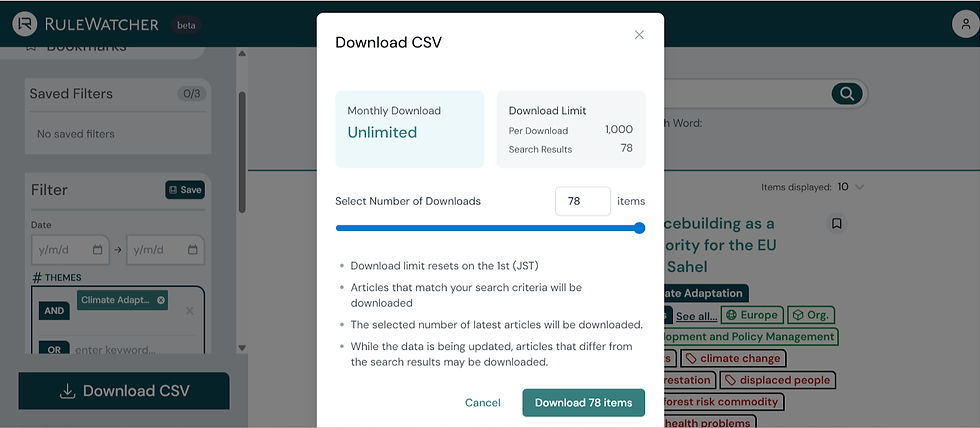
Figure 4. Download articles in CSV format
Integration of the RuleWatcher with Other Tools
The CSV outputs from the RuleWatcher (Figure 5) were efficiently structured for AI-based analysis. Fields such as summary, themes, tags, and country facilitated thematic clustering, keyword extraction, and profile filtering. This impressive compatibility features with generative AI made the RuleWatcher more effective for synthesising complex data. I exported the dataset as a CSV file, which allowed me to process the information further and use ChatGPT to analyse it.

Figure 5. CSV outputs from the RuleWatcher
With AI summarizations tools, External Tools used with the RuleWatcher platform to analyze and summarize the extracted data are as follows:
(i) Excel was used for cleaning and filtering the exported data.
(ii) ChatGPT (generative AI) was used to paraphrase, summarize, and cluster findings across documents.
This mixture worked mainly fine; however, the RuleWatcher provided organized access. Although AI offered a logical explanation for the data collected and selected from the extracted CSV files, this were then transferred to ChatGPT for further analysis and summarization, as seen below (Figure 6).

Figure 6. ChatGPT analysis
Findings and usefulness
This study found that the RuleWatcher is a transformative tool for information access in the digital age. Some of the key themes identified by the RuleWatcher, including climate mitigation and climate adaptation, have presented 197,314 results on articles related to climate change and mitigating of herders-farmers violence in South Sudan.
However, government regulation aimed at mitigating herders-farmers conflict is an obligation and duty in conformity with the constitution of the Country. Under corporate and public sector responsibilities, there has been an increasing emphasis on how both governments and private actors, such as civil society organizations, business firms, NGOs, and UN agencies, as Country stakeholders, have contributed material and moral support building peace and coexistence programs.
In conflict mitigation, peace building, climate change, and coexistence between cattle herders and farmers, several initiatives and negotiations have been conducted between the two communities, with broader determinants including the maintenance of security, addressing climate change, and mutual respect, especially in herder-farmer conflict regions.
On the other hand, the most common tags included were 'climate mitigation' and 'government regulations' (in all articles), which reinforce the primary concern of global climate change, regulation, and environmental policy. Due to financial reforms and pandemic responses, there are significant driving forces behind current policy changes. All articles were tagged as Multinational, indicating international frameworks.
Some locations mentioned include Africa, Brazil, Tanzania, the EU, and the Global South, highlighting disparities between high- and low-income countries in policy implementation.
Significant policy changes with global impact include ecological solutions, such as reducing agricultural ammonia emissions, which requires governments to reshape policies that promote the well-being of their people by improving their living standards through the injection of substantial aid into developing sound socio-economic infrastructure and innovation across the nation.
Comparison with Other Platforms
While platforms such as ResearchGate, Direct Science, LexisNexis, PolicyMap and GovTrack provide partial data, they lack the integrated, real-time policy intelligence offered by the RuleWatcher. Its comparative advantage lies in unifying governance, legal, and environmental information with AI-driven analysis. The CSV system allows for the gathering of a large volume of files,which can be downloaded at once and analyse and summarize them using AI such as ChatGPT, while others platforms do not offer the same functionality.
Conclusion and Future Perspectives
This research concludes that governments must assume primary responsibility for protecting vulnerable populations, ensuring food security, managing resources effectively, and promoting peaceful coexistence. UN-backed peacebuilding programs
in regions such as Benue and Nasarawa in Nigeria demonstrate how integrating humanitarian aid, economic interdependence, and dialogue platforms can address the root causes of conflict.
RuleWatcher strengthens these efforts by making policy insights more accessible, connecting national strategies to global initiatives, and equipping stakeholders with timely information.
Potential for Future Use
Given the constant need for updated and reliable data, the RuleWatcher holds immense promise for future research and governance.
Students, researchers, policymakers, and practitioners can continue to rely on it as a standard, affordable, and comprehensive tool for tracking information and guiding evidence-based solutions.
References
Africa Livestock Transformation, AFDB 21-23 Oct 2015. https://www.afdb.org/fileadmin/uploads/afdb/Documents/Events/DakAgri2015/AfDB_Livestock_Background_Paper.pdf
MARF-RSS, Livestock policy framework and strategic plan, 2012-2015. https://faolex.fao.org/docs/pdf/ssd152370.pdf
From Uruguay to Ethiopia: Innovation in sustainable. World Bank,03/07/2024
FAO, National Livestock policy, Kenya, 01/11/2008 https://www.fao.org/faolex/results/details/en/c/LEX-FAOC159358/
Determinants of smallholder commercialisation of livestock: A case Study from Tigray, Ethiopia, 04 August 2021.
Samuel Jegede, Published 11. Dec 2023. Transforming traditions in central Nigeria, Conflict often arises when communities are forced to compete for the same resources. In central Nigeria, the Norwegian Refugee Council (NRC) is supporting farmers and herders to move towards a more sustainable – and harmonious – future.
01/09/2025 - How measures to protect the environment and reduce the rich–poor divide interact
Kożuch, A. (2025).
Characterisation and Evaluation of the Organisational and Legal Structures of Forestry in the European Union. Sustainability, 17(13), 5706.
Brazilian Government launches public panel with 250 actions of the Ecological Transformation Plan
Planting Change |Karuna. https://www.karunanews.org/story/14418/planting-change
Transforming traditions in central Nigeria | NRC. https://www.nrc.no/perspectives/2023/transforming-traditions-in-central-nigeria/


Comments