

.png)
Connecting the Dots in Global Supply Chains with RuleWatcher
- Publishing Team

- Aug 31, 2025
- 6 min read
Updated: Jan 29
Key Findings
The research shows that the current sustainability regulations, especially from the European Union, are placing pressure on suppliers in countries like Vietnam to meet strict standards on traceability, labor, and the environment.
Using RuleWatcher revealed how quickly these policies are changing across different regions, and how important it is to track them in real time. RuleWatcher's ability to search across languages and countries made it efficient to identify both risks and opportunities in global supply chains.

Author
Kai Hirai Tschang
Honors Undergraduate Student,
Finance and Supply Chain Management, Iowa State University, Ames, Iowa
Introduction
It’s hard to keep up with the world of global supply chain when the laws shift faster than the blink of an eye. In modern times, despite easy internet access, many of us face language barriers when trying to access local articles in a non-English-speaking country. This crucial global policy information is scattered across the vast web or stored in slow databases that occasionally update. RuleWatcher is a promising tool that can help solve this problem by providing easy access to cross-border information.
The company that created this product, OSINTech, stays true to an important goal. “Our world. Rules by everybody.” As rapid technological advancements take the world by storm, people are wondering whether their jobs are at risk of being replaced by artificial intelligence. Rather than falling behind, the people who have the knowledge and skills to engage and utilize the AI’s strengths are those who will be best positioned for success in the digital economy.
Background
As a first-year undergraduate student at Iowa State University, studying Finance and Supply Chain Management, I am no stranger to the themes offered by RuleWatcher. However, my university, just like many business schools in the U.S, prevents students from immediately diving into their business classes. Often, the first two years are spent taking various business-related core classes such as economics, calculus, and philosophy. While these classes are interesting and have enriched my first year of university studies, I wanted to learn more about my majors, especially Supply Chain Management.
The main reason for this is my future career aspiration which is to land a supply chain role by incorporating my finance background. Throughout my career, I would also like to advocate for sustainability and its importance in the modern industry. However, interest in sustainability across varying sectors is a recent change, and high schools are yet to teach students about it. One of these rare opportunities is in a class I plan to take in my later years as a university student. The class is titled Supply Chain Management 4710: Sustainable SCM. As an upper-level Supply Chain Management class, it requires an in-depth understanding of global governmental policy and how supply chain design and execution will affect sustainability. I have been utilizing RuleWatcher as a way to begin learning about sustainability in supply chain, so that when the time comes, I can find success in that class.
Research Purpose & Global Issue
The problem many global supply chains face is the lack of consistent sustainability laws. Companies face varying obligations depending on which regional borders they cross. This can make it hard to simultaneously meet all the expectations set by the company's higher-ups and satisfy all the goals set by governments. My goal was to utilize RuleWatcher (RW) to explore an industry within an Asian country and examine how it is addressing this matter. I chose to focus on Asia, as the usage of the transition tool in RW revealed that the region is undergoing ongoing changes, with a high volume of articles emerging related to “Sustainability” and “Supply Chains”.
How RuleWatcher Was Used

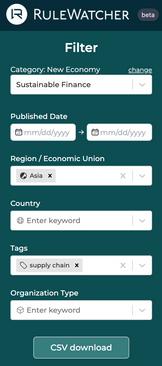


First, I logged into RuleWatcher and selected "New Economy" as my category, then chose "Sustainable Finance" within that category.

I added 'sustainable' in the search bar as an extra effort to filter the articles related to sustainability.

I inserted 'Asia' as the region, as I wanted to focus on ASEAN and possibly other Asian countries.

Lastly, I inserted the tag ‘supply chain’, which pulled up all the articles the AI tagged as supply chain.

In the image above, you can see the trend mentioned by country. It’s important to note that this was done without the Asia region filter, as I was curious to see which countries were often mentioned with sustainable supply chains. Asia and Europe were well represented, and I was already planning to study Asia, so this reassured me that I had made a strong choice. You can find this page by clicking on the "Transition" tab, located next to the "Search" and "Treemap" tabs.
How RuleWatcher was used in hand with ChatGPT (generative AI)
While RuleWatcher provides you a database of primary information it doesn’t summarize the information to you. As the user you can take advantage of tools such as ChatGPT to summarize or analyze the key articles from your search results. I utilized ChatGPT to give me a bullet point summary of my article “New EU regulations are reshaping the cocoa industry” before I started reading so that I could go into my reading knowing what to expect and that it was of use to me. It also assisted me with simplifying and maintaining a professional tone for the key findings section of this article.
Research Results
The European Union (EU) has determined to set strict sustainability regulations that will affect global agricultural supply chains, such as the Cocoa operations. Three specific examples are the Corporate Sustainability Due Diligence Directive, the EU Deforestation Regulation, and an upcoming Forced Labour Regulation.
While the target is large-scale companies, implementing the previously mentioned measures will affect supply chains throughout the global cocoa industry. In countries like Vietnam, the small and mid-sized suppliers are also affected. While the article mentions that this could also be an opportunity for growth for companies willing to adopt transparent and environmentally friendly initiatives, these changes will likely cut down on the sections of the supply chain in Vietnam that cannot adapt to reporting clear, traceable information. If they cannot provide legal documentation of ethical labor practices and efforts to counteract deforestation, they risk being removed from the supply chain entirely by major importers in the EU. Businesses in Vietnam need to carefully review their procedures and update their supply chain processes to meet the new EU standards.
This information provided by the Vietnamese government is crucial to be aware of for businesses that are affected. Those businesses that are less informed and left out of the media cycle will be shocked by sudden changes. Not only in Vietnam but globally awareness of policy changes are key to succeeding in the supply chain industry. This is one example of how supply chain sustainability is becoming less voluntary and more of a legal requirement. Those that fail to comply, will lose access to the market of an entire country or worse a region.
Comparison with Other Tools
Throughout my exploration of RuleWatcher as a tool, I have made a few important realizations that were hard for me to see when I first learned about the product. The first is the misunderstanding of RuleWatcher’s value as a search engine. Powerful search engines already exist in the form of Google, which is one of the best ways to do quick searches and has well-integrated AI answers to support and summarize information. Browsing through the changes in supply chain policies in Asia and picking up the article about how EU regulations affect Vietnam opened my eyes to how vital RuleWatcher can be as a policy tracking software. Being able to follow both broad and very specific changes in an industry of choice, like the cocoa industry, can be the key for a company to get ahead of its competition. I believe that rule watching and awareness of the big picture will become increasingly crucial as inevitable economic and political changes near.
Evaluation and Future Potential
There is considerable potential in the educational sector, particularly in high schools in Singapore. From my experience attending an international school in Singapore, students will be tasked with topics related to environmental sciences as schools become more aware of the importance. Students are also required to use trustworthy sources and are held to a high standard of research. I believe high schools will be interested in using RuleWatcher, as it doesn’t do the research for the students and still requires them to think and read through the articles. Another key feature of RuleWatcher is that it allows users to find articles in foreign languages without having to search in that language. Searching in Google with “sustainability,” for example, will only bring up articles in English related to sustainability, while in RuleWatcher, it will pull information from other languages.
Many international students in Singapore are from multicultural backgrounds and are passionate about their ethnic heritage. However, their level of comfort with conducting research and reading in that language may vary, which could deter them from using foreign languages during research projects. Another issue with using foreign language articles in international schools is that teachers often want to ensure the student's sources are strong articles and may be against a student using an article in a language they cannot read. By taking advantage of RuleWatcher’s features, students can efficiently search for content related to various important ESG topics, find trustworthy sources from reputable organizations such as governments and NGOs, and also explore across regional borders to expand their research options.


Comments