Two Paths to AI Governance: What RuleWatcher Reveals About Malaysia and Singapore Author Information
Plan of theme:
biz.
Treemap
Transition
CSV Download


AUTHOR
May Thiri Khit
Graduate Student, Master of Business Administration (Ritsumeikan Asia Pacific University, Japan)
Key Findings
RuleWatcher provided 18 relevant articles about AI Governance among Malaysia and Singapore between (2023-2026).
Malaysia’s policy discussion emphasizes adaptive governance, national coordination, risk management and support for MSMEs.
The debate in Singapore centres on legal adaptability, cross-border regulation, technological competitiveness and its geopolitical exposure.
Both countries prefer flexible governance approaches, but their priorities reflect different economic and institutional positions.
Overview
Artificial intelligence is creating significant economic opportunities all over Southeast Asia. However, it also raises concerns about privacy, safety, accountability and unequal access to technology. In Malaysia and Singapore (two key economies in the ASEAN region), actions are being taken to meet these opportunities and risks, but, because of the differences in their level of technological development, business structures and degree of international involvement, the two countries may end up with different governance priorities (Economic Research Institute for ASEAN and East Asia [ERIA], 2025).
Malaysia is trying to improve domestic coordination by empowering a central national AI agency, developing a flexible regulatory framework and strengthening AI readiness among institutions, businesses and the public (Tan, 2024). At the same time, policymakers need to ensure that micro, small and medium-sized enterprises are not excluded from the AI-adoption process (Gong, 2024).
Singapore as a global tech investment center has complicated governance issues relating to cross-border data flows, intellectual property rights, ownership of technology, and foreign investments (Kam, 2026).
This use case applies RuleWatcher to examine a central question “How do AI-governance priorities differ between Malaysia and Singapore, and what common challenges do the two countries face?”
About case
This study focuses on development of AI governance in Malaysia and Singapore by means of the institutional publications gathered via RuleWatcher, with a focus on documents issued between 2021 and 2026 that deal with AI governance, responsible AI, legal developments, institutional coordination, business adoption and regional cooperation.
How RuleWatcher Was Used
Opened Search Across All Themes.

Figure 1. RuleWatcher “Search Across All Themes” Page
Conducted three exact-phrase searches: Artificial Intelligence, AI Governance, Responsible AI. Set the period from 1 January 2021 to August 2026. Then, selected ASEAN under Region. Finally, applied the organisation filter.
RuleWatcher search results for “Artificial Intelligence”
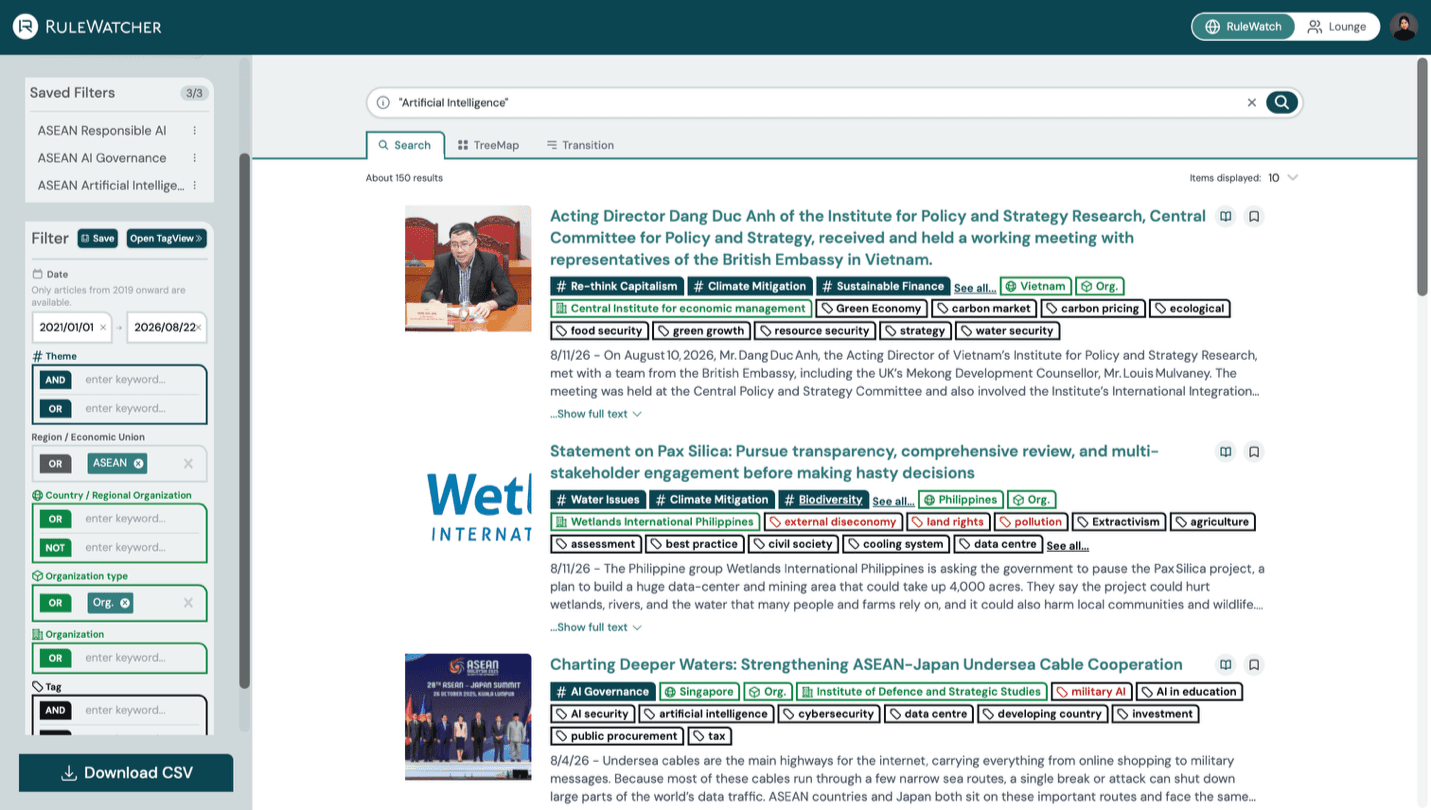
Figure 2. RuleWatcher Search Results for “Artificial Intelligence”
RuleWatcher search results for “AI Governance”

Figure 3. RuleWatcher Search Results for “AI Governance”
RuleWatcher search results for “Responsible AI”

Figure 4. RuleWatcher Search Results for “Responsible AI”
After careful reading of each article under each search word, I selected “AI Governance” as the main search because the articles from that search word are more related to my questions. Then, I used Treemap to identify themes.

Figure 5. Initial TreeMap of Themes Related to AI Governance
Entered “military” and “new weapons” in the NOT search field to exclude results unrelated to the research scope and refine the dataset. Therefore, there were only 21 articles left in the dataset.

Figure 6. Refined TreeMap After Removing “Military AI” and “New Weapons
Used Transition to examine country and time patterns by turning on Display “Multinational” to check for regional ASEAN-level results. Although I filtered between 2021 and 2026, the articles were published from 2023.

Figure 7. Country Mention Trends from 2021 to 2026
The result showed that Malaysia and Singapore had the most sustained presence in the selected results.
Out of the 21 articles exported in the CSV dataset, 18 were associated with Malaysia (11 articles) and Singapore (7 articles). Due to this high concentration of relevant literature, I decided to work on Malaysia and Singapore.

Figure 8. CSV Export of the Selected RuleWatcher Articles
Comparative Findings
Malaysia | Singapore |
Governance approach | |
|
|
Institutions and coordination | |
|
|
Businesses and inclusion | |
|
|
Risks and international positioning | |
|
|
Table 1. Comparison of AI Governance Priorities in Malaysia and Singapore
Combining with external tools
RuleWatcher made it possible to locate institutional publications on a single platform. By using the filters, a wide search was narrowed down to a manageable amount of data. Exporting from CSV format made it easier to compare. The data that had been exported was then examined using NotebookLM in order to organise the themes and to identify possible comparisons. Nevertheless, the original RuleWatcher records stayed the main evidence and important claims were verified by referring to their source documents. Unlike a general search engine, RuleWatcher provided a more structured method for discovering and analysing materials relating to policy.
Limitations
Many studies originated from few research institutions, while other studies involved policy analysis but were not government policies. Classifications of the country depended on the geographical position of the publishing house rather than the content of the article. In this way, publication numbers are not an indicator of the quality of governance. Although the selected search period covered 2021–2026, no significant results appeared in 2021 or 2022, and relevant articles began appearing only in 2023. Therefore, the findings mainly represent developments between 2023 and 2026. These limitations mean that publication numbers should not be interpreted as an indicator of the quality of AI governance in each country.
Conclusion
Overall, RuleWatcher was useful for identifying and comparing AI-governance developments in Malaysia and Singapore. The TreeMap and Transition functions revealed connections between AI governance and areas I had not initially considered, including MSME inclusion, digital skills, international investment and geopolitical risks. In the future, I can use RuleWatcher to monitor new AI policies and examine how regulatory changes affect businesses and society.
References
Economic Research Institute for ASEAN and East Asia. (2025, May 30). Harnessing AI for ASEAN’s future: Governance, adoption, and sustainability under the DEFA. Retrieved August 25, 2026, from RuleWatcher: https://app.rulewatcher.com/articles/9b234542-bb90-4494-af18-61596ea1cc53?from=search
Fong, K. S. L. (2023, August 7). ASEAN’s new dilemma: Managing the artificial intelligence space. ISEAS–Yusof Ishak Institute. Retrieved August 25, 2026, from RuleWatcher: https://app.rulewatcher.com/articles/841ab91e-28e5-4570-a954-edb6c2f61709?from=search
Gong, R. (2024, October 30). Not leaving MSMEs behind in the AI race. Khazanah Research Institute. Retrieved August 25, 2026, from RuleWatcher: https://app.rulewatcher.com/articles/97f97ba3-6daa-43ed-965f-12816da8fe52?from=search
Gong, R. (2025, February 21). Malaysia’s role in global AI governance. Khazanah Research Institute. Retrieved August 25, 2026, from RuleWatcher: https://app.rulewatcher.com/articles/5d0acd2a-33fd-4231-aca1-5cccafb0899c?from=search
Gong, R., & Khoo, W. Y. (2025, February 26). What AI risks concern Malaysia? Khazanah Research Institute. Retrieved August 25, 2026, from RuleWatcher: https://app.rulewatcher.com/articles/c10865ac-eb35-465b-bd7c-161dc83b8e29?from=search
Kam, S. (2026, May 4). Global China, China-shedding and Southeast Asia’s regulatory challenge. S. Rajaratnam School of International Studies. https://app.rulewatcher.com/articles/849ec6da-8b2c-4cd0-83e7-c3656dd2f35c?from=search
Said, F., & Nabilah, F. (2024, December 9). Future of Malaysia’s AI governance. Institute of Strategic & International Studies Malaysia. Retrieved August 25, 2026, from RuleWatcher: https://app.rulewatcher.com/articles/384d2e40-e62d-4b74-ac4d-2ab02495dd4f?from=search
Tan, J.-E. (2024, November 29). Navigating Malaysia’s AI future: Toward coordinated and adaptive governance. Khazanah Research Institute. Retrieved August 25, 2026, from RuleWatcher: https://app.rulewatcher.com/articles/23006900-02d4-4ee4-afb4-0b0af1ae5062?from=search
Tan, J.-E. (2025, March 3). Finding the right balance: Governing AI in a rapidly evolving future. Khazanah Research Institute. Retrieved August 25, 2026, from RuleWatcher: https://app.rulewatcher.com/articles/e24be827-5deb-4129-91d7-a742537c210e?from=search
Tan, J.-E., Gong, R., Khoo, W. Y., & Nik Sharifulden, N. S. A. (2025, January 28). AI governance in Malaysia: Risks, challenges and pathways forward. Khazanah Research Institute. Retrieved August 25, 2026, from RuleWatcher: https://app.rulewatcher.com/articles/3ce2320a-7f9c-4d9e-98bb-a3ae2b34b70d?from=search
Thongmeensuk, S. (2024, September 11). Europe’s AI Act will shake up businesses. Thailand Development Research Institute. Retrieved August 25, 2026, from RuleWatcher: https://app.rulewatcher.com/articles/e926de6d-1f00-4746-bd69-e07d009c6621?from=search