Comparative Discourse Analysis of Myanmar's Socioeconomic Conditions: Government and International Reporting through RuleWatcher
Plan of theme:
Plus
Filter Saving
Treemap
Country / Region Filter
Transition
CSV Download

AUTHOR
Anonymous
Master's Student, Kobe Institute of Computing (KIC), Japan.
Key Findings
Myanmar's own government portal is not RuleWatcher's only source on the country. It just takes a different kind of search to reach the rest. A search narrowed to Myanmar as a country shows only the government's side; searching "Myanmar" as a plain keyword opens up reporting from around the world.
RuleWatcher's Transition view made it possible to find which countries report on Myanmar the most, without guessing or searching country by country. It pointed directly to Japan, Indonesia, the UK, Thailand, and the USA.
Comparing those five countries properly meant looking at more than just topics, it meant seeing which types of organizations were reporting (government, parliament, or NGO) and how much of each country's coverage touched on issues like refugee issues. Exporting each country's full result set is what made that level of comparison possible.
The comparison showed that each country reports on Myanmar for a different reason: Japan as a donor, Thailand as a neighboring host country, the UK through parliamentary debate, the USA through global human-rights monitoring, and Indonesia mostly through diplomacy plus, in some cases, correcting misinformation.
Overview
I wanted to understand Myanmar's current situation, not just what the government says, but also what international organizations are reporting. Myanmar doesn't have much independent media coverage compared to other countries, so I was curious whether RuleWatcher's database would reflect that gap, and whether there was a way to search around it.
How I used RuleWatcher step by step
I started with the most obvious approach: filtering by Country, set to Myanmar. This gave me 1,806 results. To get a quick sense of what those results actually covered, I switched to RuleWatcher's TreeMap view: this shows all the results as labeled blocks, sized by how many articles fall under each topic, so you can see the overall shape of a search without reading every article. In this case, every block traced back to the same single source: the Myanmar National Portal.
Search results for Myanmar (Country filter applied)
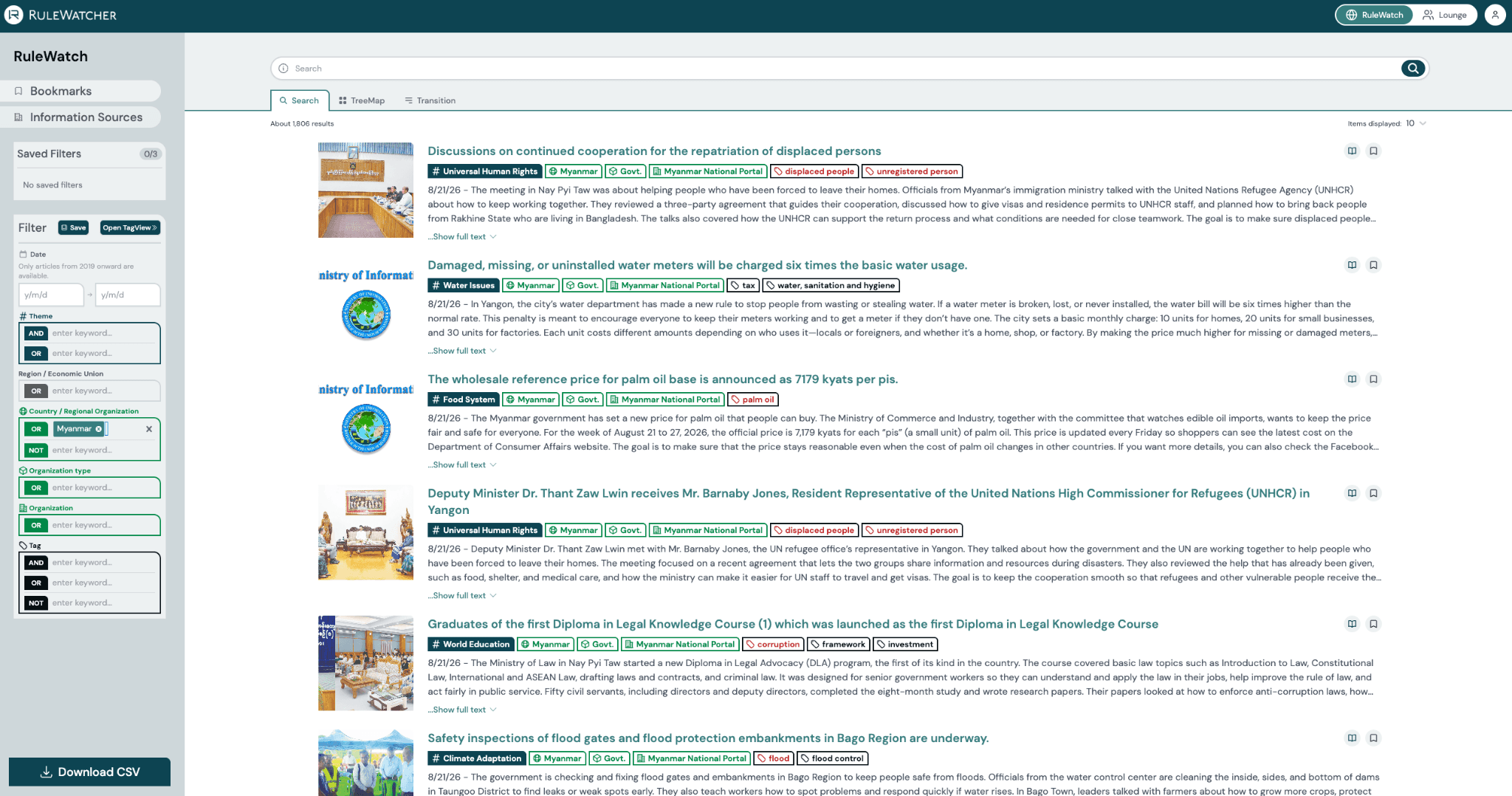
Looking at the TreeMap more closely, its coverage is broader than "official achievements only." Alongside training courses, ceremonies, and government visits, it also reports on flood damage, farming support, healthcare, and support for workers and children. So the government source does cover hardship-related topics, the difference is more likely in framing than subject matter, with difficult events often paired with the government's own response.
TreeMap: Myanmar National Portal coverage (Country filter = Myanmar)

So I tried a different approach: I removed the country filter completely and just searched the keyword "Myanmar" across all themes. This gave a much larger result set: 14,372 rows. This time, the TreeMap looked completely different: new topic blocks appeared, and they traced back to sources I hadn't seen before, including the World Food Programme, the European Commission, and Japan Platform.
Search results for "Myanmar" keyword (Country filter excluded Myanmar)

TreeMap: Global coverage of Myanmar(Country filter excluded Myanmar, Item displayed - 500)

Removing the country filter and searching "Myanmar" as a plain keyword substantially changed the picture. Topics that never appeared in the government portal's TreeMap showed up, including Military Coup, Rohingya Refugees, Refugee Camp, Human Trafficking, Years of Fighting, Migrant Workers and their Families,and Leaving their Homes. These aren't just a different framing of what the government already covers; they're subjects the government portal doesn't seem to report on at all. Alongside these, the TreeMap also showed a strong regional angle such as ASEAN Work, International Cooperation, Helps China, Korea's Help, Thailand are Working, South China Sea. Pointing to Myanmar being discussed as part of wider regional politics and aid relationships, not just as its own domestic story.
What the Government Says
Looking at the TreeMap more closely, the Myanmar National Portal covers a broader range of topics than expected. Alongside official activity such as training courses, ceremonies, and government visits, it also reports on topics like flood damage, farming support, healthcare, and help for children and workers. So the government source is not silent on hardship-related topics; it does cover things like flooding and farm struggles.
What differs is likely the framing rather than the topic itself. Based on the block labels, the government's coverage tends to describe these events alongside the response: for example, flood damage appears next to blocks about the government helping villagers, building better infrastructure, and supporting farmers. This suggests a pattern worth checking more closely once the full article content is reviewed: government reporting may present hardship as something already being addressed, while international sources may report on the scale or severity of the same hardship without that framing.
What International Sources Say
The keyword search introduced topic blocks that never appeared under the country-filtered search at all: Military Coup, Rohingya Refugees, Refugee Camp, Human Trafficking, Years of Fighting, Migrant Workers and their Families, and Leaving their Homes. These are not simply a different framing of topics the government source already covers, they are subjects the government source appears not to report on at all.
Alongside these, the keyword search also surfaced a strong regional and international dimension: blocks like ASEAN Work, International Cooperation, Helps China, Korea's Help, Thailand are Working, and South China Sea point to Myanmar being discussed as part of wider regional politics and aid relationships, not just as a standalone domestic story.
I also checked the Transition view to see who was actually talking about Myanmar. This chart shows how often each country has published a keyword over time. It pointed clearly to five countries reporting on Myanmar the most: Japan, Indonesia, the UK, Thailand, and the USA. That's why I chose these five countries to dig deeper, filtering the keyword search by each one, to see exactly what they were saying about Myanmar in detail.
Transition view: Mention trends by country over time

Then, while filtering by each country, I downloaded the CSV for that country's results. The CSV gave me every article as a row, with columns for the date, title, organization, organization type, url, summary, content and so on. This helped a lot, because instead of reading through articles one by one, I could open the file and immediately see patterns which organizations kept showing up, how often, and what themes their articles fell under across hundreds of articles at once.
CSV export sample: Japan dataset

What the Five Countries Say
Each of the five countries covers Myanmar through a different lens, and RuleWatcher's export made it possible to see this clearly instead of guessing from headlines alone:
Japan — coverage is led by the Ministry of Foreign Affairs and the NGO Association for Aid and Relief Japan (AAR Japan), focused on grant aid and refugee support. For example, Japan's Ministry of Foreign Affairs signed grant aid agreements for health and protection projects for Myanmar refugees in Bangladesh and Thailand in early 2026.
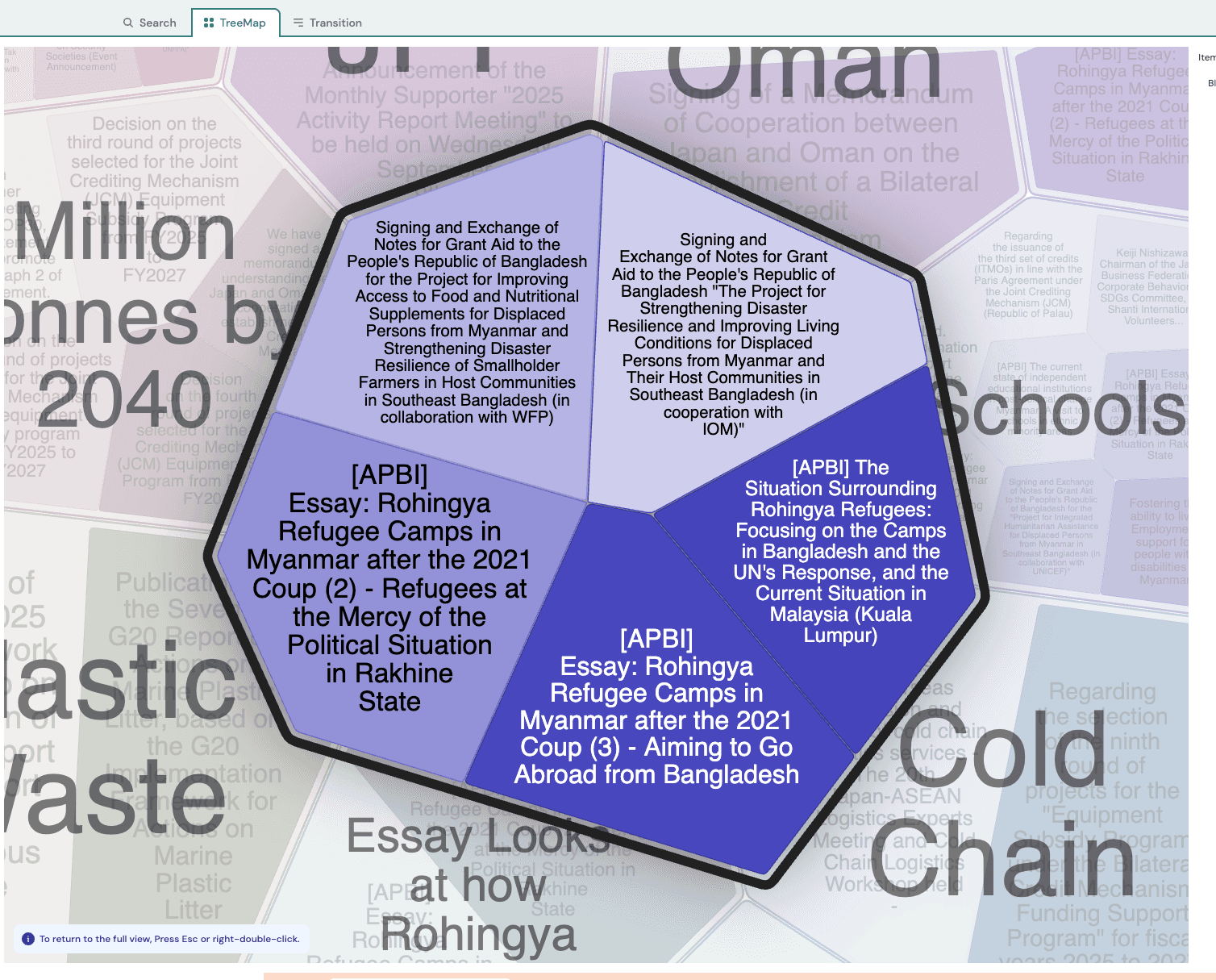
TreeMap: Japan's coverage of Myanmar

TreeMap drill-down: Japan's Rohingya refugee camp articles
Indonesia — coverage is almost entirely government and parliamentary, focused on diplomacy, trade, and regional stability (ASEAN, the South China Sea, trade targets). Its Rohingya-related coverage is mostly indirect: nine articles from Indonesia's communications ministry debunk hoaxes about Rohingya refugees in Indonesia, mentioning Myanmar only as the country they fled from, not as the article's main subject. A few went further: Indonesia's Foreign Minister is quoted at the UN calling for an end to the conflict in Myanmar so refugees can safely return home but most of this coverage is really about Indonesia managing its own misinformation problem, with Myanmar as background context.
TreeMap: Indonesia's coverage of Myanmar

UK — has the most parliamentary content of the five countries, and the highest share of Rohingya/refugee-related coverage. Much of this comes through UK Parliament debates and UK Government statements, including funding announcements for Rohingya refugees and human rights positions raised at the UN Human Rights Council.
TreeMap: UK's coverage of Myanmar

Thailand — is almost entirely government-sourced, similar in pattern to Myanmar's own national portal. But the content is different: Thailand's Ministry of Public Health and government reports describe healthcare access and work permissions for people who fled fighting in Myanmar into Thailand, treating it largely as a domestic health and labor matter.
TreeMap: Thailand's coverage of Myanmar

USA has the highest share of coverage from independent organizations among the five countries, with most coverage coming from NGOs and think tanks such as the Council on Foreign Relations and the Committee to Protect Journalists. Myanmar tends to appear as one example within larger global stories , for example, coverage of declining US refugee admissions overall, or press freedom for journalists in exile worldwide rather than as a dedicated Myanmar story.
TreeMap: USA's coverage of Myanmar

What This Means
Comparing the government portal with these five countries shows that "how a country is covered" depends heavily on who is doing the covering and why. Thailand and Myanmar's own portal are both government-dominated, but Thailand frames Myanmar as a neighboring humanitarian and labor issue, while Myanmar's own portal frames its hardships alongside its own response. Japan and the UK cover Myanmar mainly through the lens of aid and human rights, with the UK doing so partly through active parliamentary debate. The USA's sources treat Myanmar as one data point within global institutional monitoring, and Indonesia's government sources spend part of their Rohingya-related coverage correcting misinformation rather than reporting new developments.
No single source, government or international, gives a complete picture on its own. Combining them shows not just more information, but different kinds of information: domestic policy response, international aid commitments, parliamentary accountability, misinformation management, and global institutional framing.
Why This Matters for Using RuleWatcher
This use case turned out to be a good demonstration of what RuleWatcher is actually useful for. A single keyword search can look limited at first, in this case, appearing to come from one government source only. But switching between Country filtering, keyword search, TreeMap, Transition, and CSV export step by step turned that single search into a five-country comparison, built entirely from primary sources with links back to the original documents. For any researcher trying to understand a country or topic that isn't well covered by a single search engine, this same step-by-step approach broad search first, then narrow by source, then compare, is likely to work just as well.
Conclusion
For Myanmar, comparing its own government portal against five countries that report on it regularly shows five distinct lenses, each shaped by how close that country is to Myanmar's real situation whether hosting refugees next door, sending aid, or watching from a distance through institutions and parliament. Understanding Myanmar's economic, health, and social conditions fully requires looking through more than one of these lenses at once, and RuleWatcher's combination of filtering, visualization, and export tools is what made that comparison possible in the first place.
References
Japan Ministry of Foreign Affairs. (2026, March 3). Signing and Exchange of Notes for Grant Aid to the People's Republic of Bangladesh for the "Protection and Health Promotion Project for Women and Adolescents Refugees from Myanmar and Host Communities in Southeast Bangladesh" (in cooperation with UNFPA). (discovered via RuleWatcher)
The Sasakawa Peace Foundation. (2026, February 6). [APBI] The Situation Surrounding Rohingya Refugees: Focusing on the Camps in Bangladesh and the UN's Response, and the Current Situation in Malaysia (Kuala Lumpur). (discovered via RuleWatcher)
Kementerian Luar Negeri (Indonesia). (2025, October 1). Foreign Minister Sugiono Urges International Unity to Address the Rohingya Crisis. (discovered via RuleWatcher)
Kementerian Komunikasi dan Informatika (Indonesia). (2024, January 27). [HOAX] Mahfud MD and the Mayor of Banda Aceh Forced Expired Rohingya Refugees. (discovered via RuleWatcher)
UK Government. (2025, September 30). UK to Fund Lifesaving Assistance to Over 500,000 Rohingya Refugees. (discovered via RuleWatcher)
UK Government. (2026, July 7). UN Human Rights Council 62: UK Explanation of Position on the Draft Resolution on Rohingya Muslims and Other Minorities in Myanmar. (discovered via RuleWatcher)
Thailand Ministry of Public Health. (2025, September 3). 12-Month Transitional Health Care Plan for Refugees Fleeing the Fighting in Myanmar. (discovered via RuleWatcher)
The Government Public Relations Department, Thailand. (2025, August 27). Government Allows Refugees Fleeing Fighting in Myanmar to Work, While UNHCR Praises Thailand as a Model for Humanitarian Care. (discovered via RuleWatcher)
Committee to Protect Journalists. (2026, June 18). World Refugee Day 2026: Supporting Journalists in Exile Amid Transnational Repression. (discovered via RuleWatcher)
Pew Research Center. (2026, August 17). Refugee Admissions to the U.S. Are Dropping Sharply in Trump's Second Term. (discovered via RuleWatcher)